Ralf Meelker · 2026
Precausal Substrate Theory
On the Nature of Reality, as I see it
Abstract
Precausal Substrate Theory (PST) proposes that spacetime, causality, matter, and the fundamental forces are not the bedrock of reality; they arise from logic alone. The sole primitive and first postulate is property differentiation (P1): the capacity for distinctions to exist at all. Property differentiation carries an asymmetric vector tension (P2) as second postulate. Third postulate is modal sublimation (P3) past a Landau-Ginzburg threshold, producing instantiated geometry along the substrate’s net direction; causality is born together with geometry. These three are the theory’s only foundational postulates; the later structural results follow from them together with three extremal selection principles (minimal KO split, maximal V7direction algebra, maximal Dixon tensor) that are natural given P1–P3 but not derived from them, and with the standard Chamseddine–Connes noncommutative-geometry machinery (inner fluctuations, the spectral action) applied to the substrate spectral triple that P1–P3 deliver. The field-normalisation coefficient e⁻¹ is derived within PST in the substrate limit, and its matching to the SM coupling (bridge premise B) is reduced to a field-strength-renormalisation identity whose internal content is fully derived; it rests on the emergence of the SM as PST’s low-energy theory together with a falsifiable renormalisation-group test it passes at one sigma, not on a free parameter, so Z² = e⁻¹ is parameter-free modulo that one falsifiable matching premise, not modulo any free constant.
From these three postulates a concrete mathematical structure follows. PST delivers general relativity, quantum mechanics, the Standard Model gauge group SU(3) × SU(2) × U(1), fermionic matter with structural spin-statistics, and the three-generation count of matter, Ngen= 3, with the Higgs identified as the projection of the substrate’s modal order parameter. The fermion mass and mixing spectrum (the Yukawa hierarchy and the CKM and PMNS matrices) is by construction not among these structural outputs. That placement is itself a theorem, not a concession: the structural layer fixed by P1–P3 is generation-symmetric at leading order, so the observed hierarchy and mixing cannot arise from it and must enter through the contingent configuration content T(C). PST predicts a Casimir correction at nanometre separations with a parameter-free, signature-distinguishable d−6 exponent, its amplitude set by a coherence scale d0 ≲ 5.3 nm; the d0-saturating scenario gives an ~10% deviation at d = 50 nm, a clean target, a null result tightening the d0 bound rather than excluding the theory. Its other quantitative result, a derived value for the Higgs self-coupling, is consistent with the Standard Model at one sigma. Among twenty-seven surveyed substrate theories (PST and twenty-six others), PST alone delivers a pre-geometric substrate, emergent spacetime, Standard-Model gauge ingredients, and the three-generation count of matter in one framework.
The deepest implication is also the simplest: the universe exists not because something caused it, but because a reality in which no distinctions are possible is not a reality at all.
Overview
The emergence chain
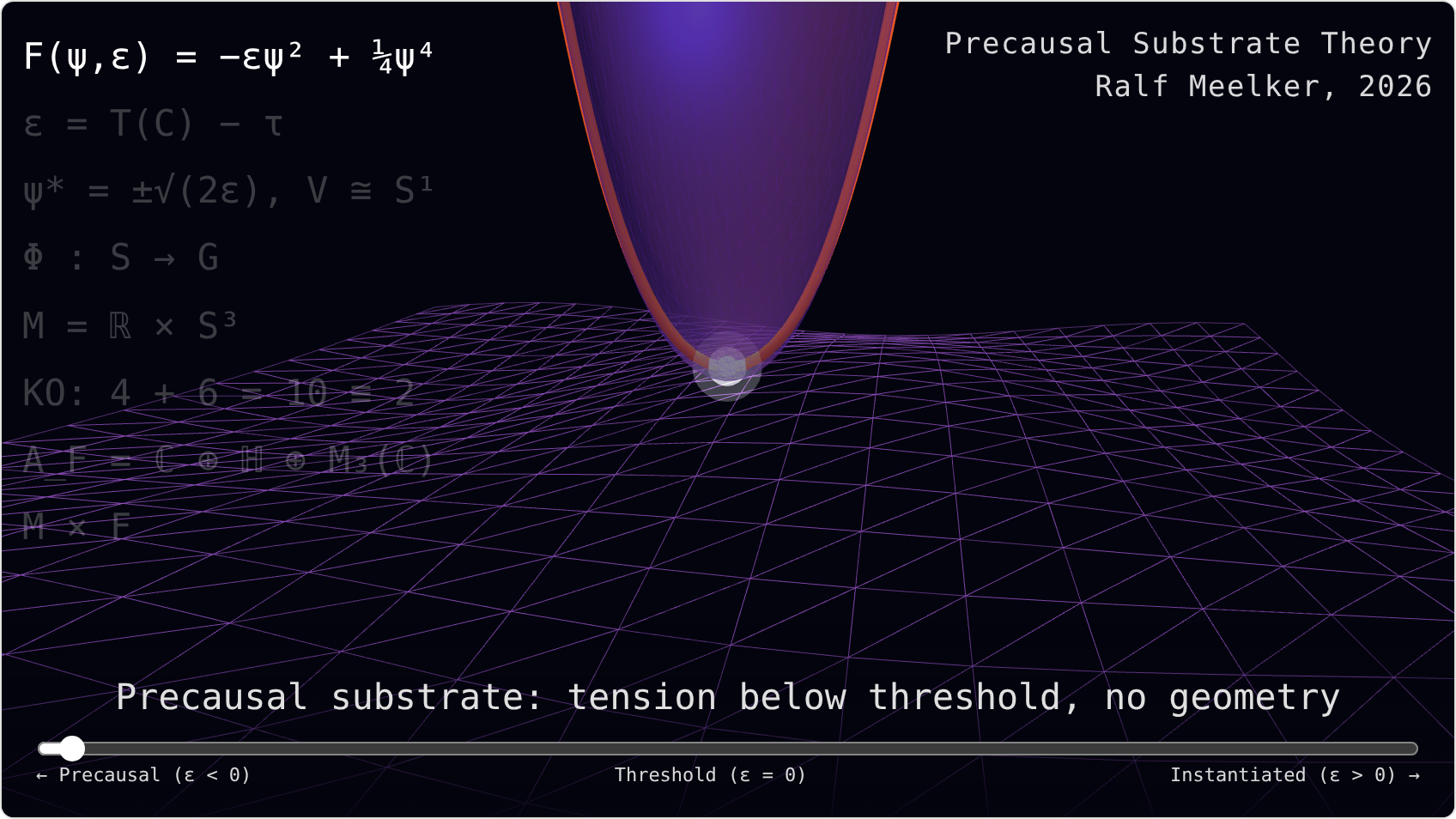
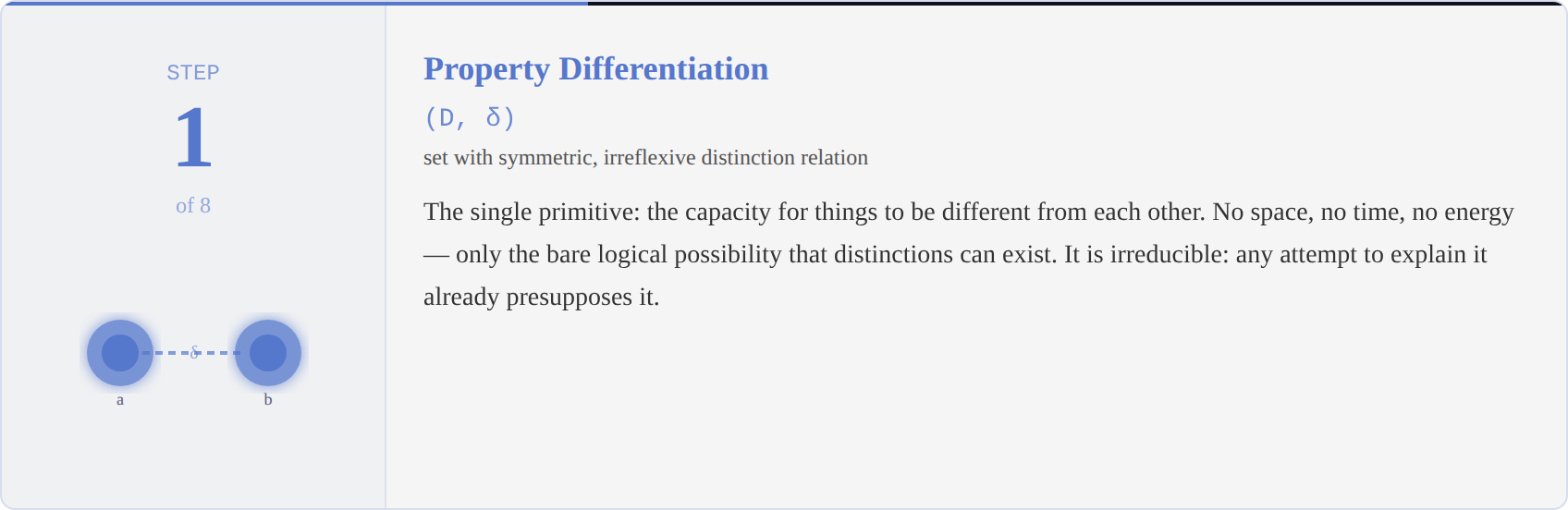
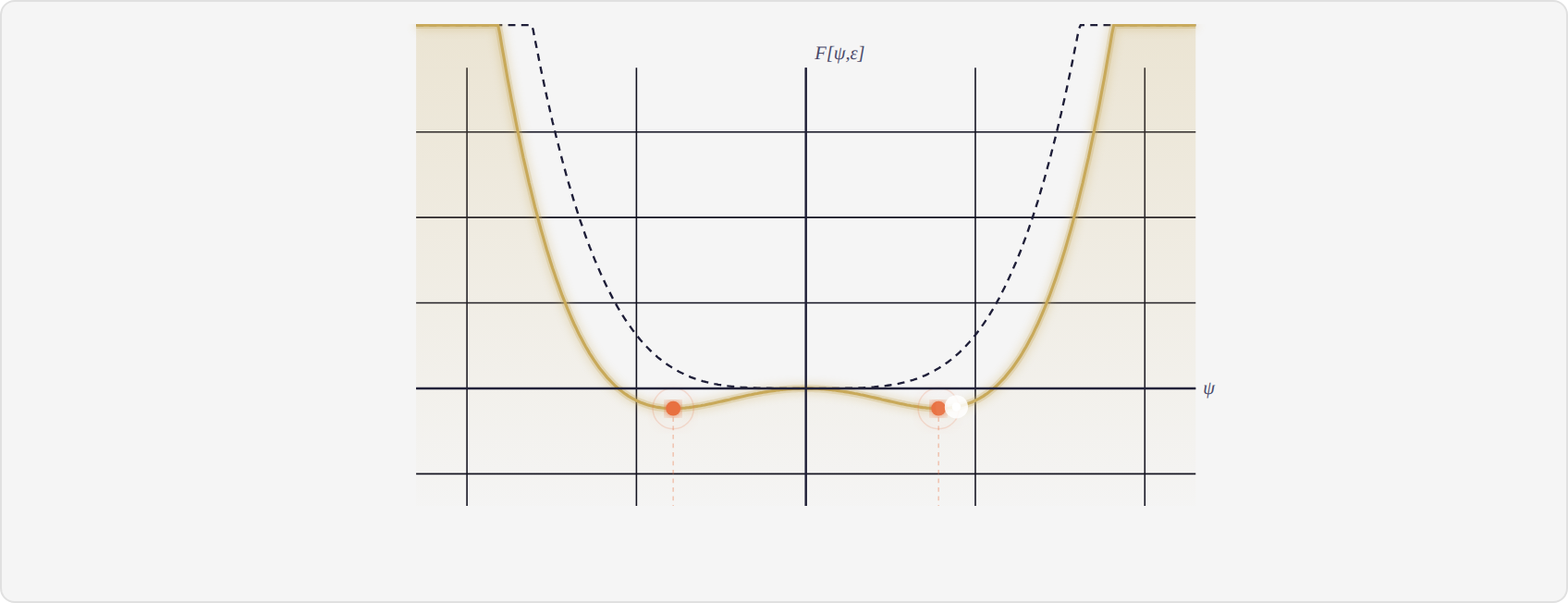
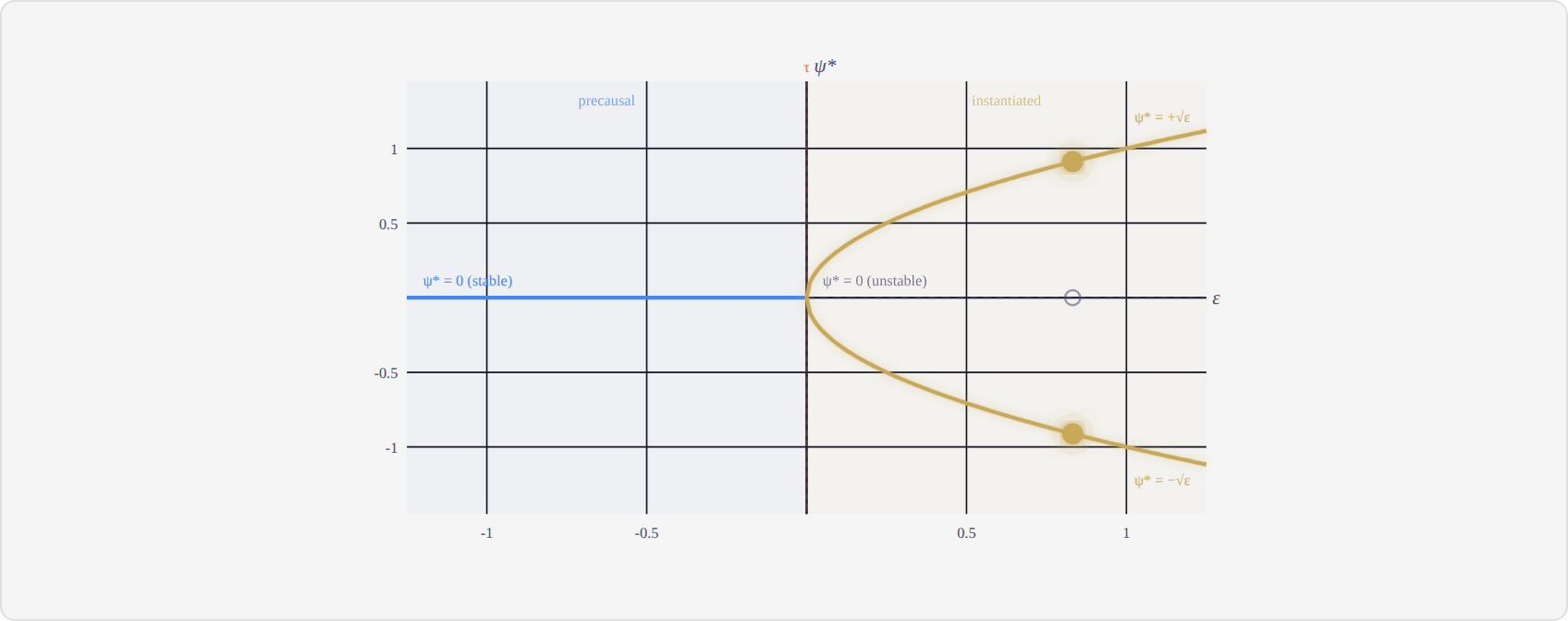
The three postulates compose into a single derivation chain rather than three independent assumptions. P1 supplies a Boolean configuration space 𝒫(D), the powerset of D substrate sites, with cardinality 2D, on which a Bernoulli product measure µ realises the principle of equal a priori weighting of distinctions. P2 endows 𝒫(D) with an asymmetric vector tension τ: each configuration carries a signed contribution τ(C) measuring its directional misalignment with the substrate’s net polarity. P3 says that when the integrated tension over a coherent region exceeds the Landau-Ginzburg threshold τ*, the substrate spontaneously breaks its Boolean symmetry and crystallises a four-dimensional ring of minima. This crystallisation event is instantiated geometry: the modal angle θ becomes the (eaten) Goldstone mode whose phase aligns into the Higgs vacuum, the radial fluctuation becomes the physical Higgs scalar, and the post-sublimation manifold M = ℝ × S³ inherits its Lorentzian signature, its macroscopic dimension n = 4, and the direction of causality from the symmetry-breaking pattern. Causality is born together with geometry, not imposed on it. Everything below operates within this post-sublimation manifold, with the substrate retained as the UV layer above the modal scale M* ≈ 1.285 TeV.
The Core Mathematics
The substrate is a real Connes spectral triple of KO-dimension six. Its Mosco limit yields spacetime M = ℝ × S³ with KO-dimension four; the product M × F has total KO-dimension ten ≡ 2 (mod 8), the Connes Standard-Model value. The substrate’s parity grading equals the Cl(0,6) chirality, and Furey’s chain-algebra construction on ℂ ⊗ 𝕆 ≅ Cl(0,6) delivers SU(3)c × U(1) on one generation. The emergent Lorentzian Dirac sector Cl(1,3) ≅ M2(ℍ) supplies an internal SU(2) via right-ℍ-multiplication on the spinor module. Combined via Dixon’s hyperspinor framework T = ℂ ⊗ ℍ ⊗ 𝕆, these synthesise to AF = ℂ ⊕ ℍ ⊕ M3(ℂ), whose unimodular unitaries are SU(3) × SU(2) × U(1).
The Unified Physics
The same spectral-triple structure delivers the four otherwise-disjoint foundations of contemporary physics. General relativity: the Einstein-Hilbert action as the leading term of the Connes spectral action Tr f(D/Λ), with Newton’s constant as a consistency relation among (mh, MP, v). Quantum mechanics: Mosco convergence of the Boolean Dirichlet forms with canonical commutation relations from the gradient structure and the Born rule from Gleason’s theorem. The Standard Model: gauge bosons and the Higgs as inner fluctuations of the Dirac operator on M × F, with φHiggs = Π(ψ) , the modal condensate and the Higgs condensate are the same field at different scales. The field-normalisation factor Z2 = e−1has its substrate side derived structurally from P1–P3 via tensor-product factorisation forced by P1’s Bernoulli product measure (Comp 100). Its identification with the SM ratio λSM(M*)/b (bridge premise B) is reducedwithin PST to a field-strength-renormalisation identity: the matching is a wave-function renormalisation, forced by P1’s product structure into the substrate-factor form (the measure-Jacobian route is excluded, Comp 103), whose substrate-side value is the embedding norm of the symmetric Higgs vacuum (the standard-EFT two-point-residue reading gives 0, disfavoured structurally and excluded by the finiteness of the quartic, Comp 114). The total reduction this requires is a unique-soft-mode theorem: the Landau–Ginzburg order parameter is the only light field, with a symmetry-protected spectral gap to all other substrate modes, because the LG potential decouples from the non-collective modes to all orders. This decoupling is exact, a non-perturbative consequence of the order parameter being the empirical mean of i.i.d. bits, a sufficient statistic (Comps 115–118, 121); the only D → ∞ limit is the value e−1 itself. The matching of this substrate factor to the SM-measured coupling remains the single open step, supported by the agreement of the predicted λSM(M*) = e−1/4 ≈ 0.092 with the running SM value at the ~0.8% level. Matter: Boolean {0,1} distinctions are fermionic occupation numbers via the CAR algebra, making spin-statistics structural. Generations: Ngen = 3 as the natural structural reading, three Fano-plane sub-algebras of 𝕆 through τ̂, with colour–generation distinguishability resolved conditional on the Dixon-synthesis block structure (Comp 48 and Comp 106); read structurally from Furey’s six-SU(3)-triplet decomposition of Cl(0,6) via the chain-algebra ℂ ⊗ ℍ ⊗ 𝕆.
Predictions
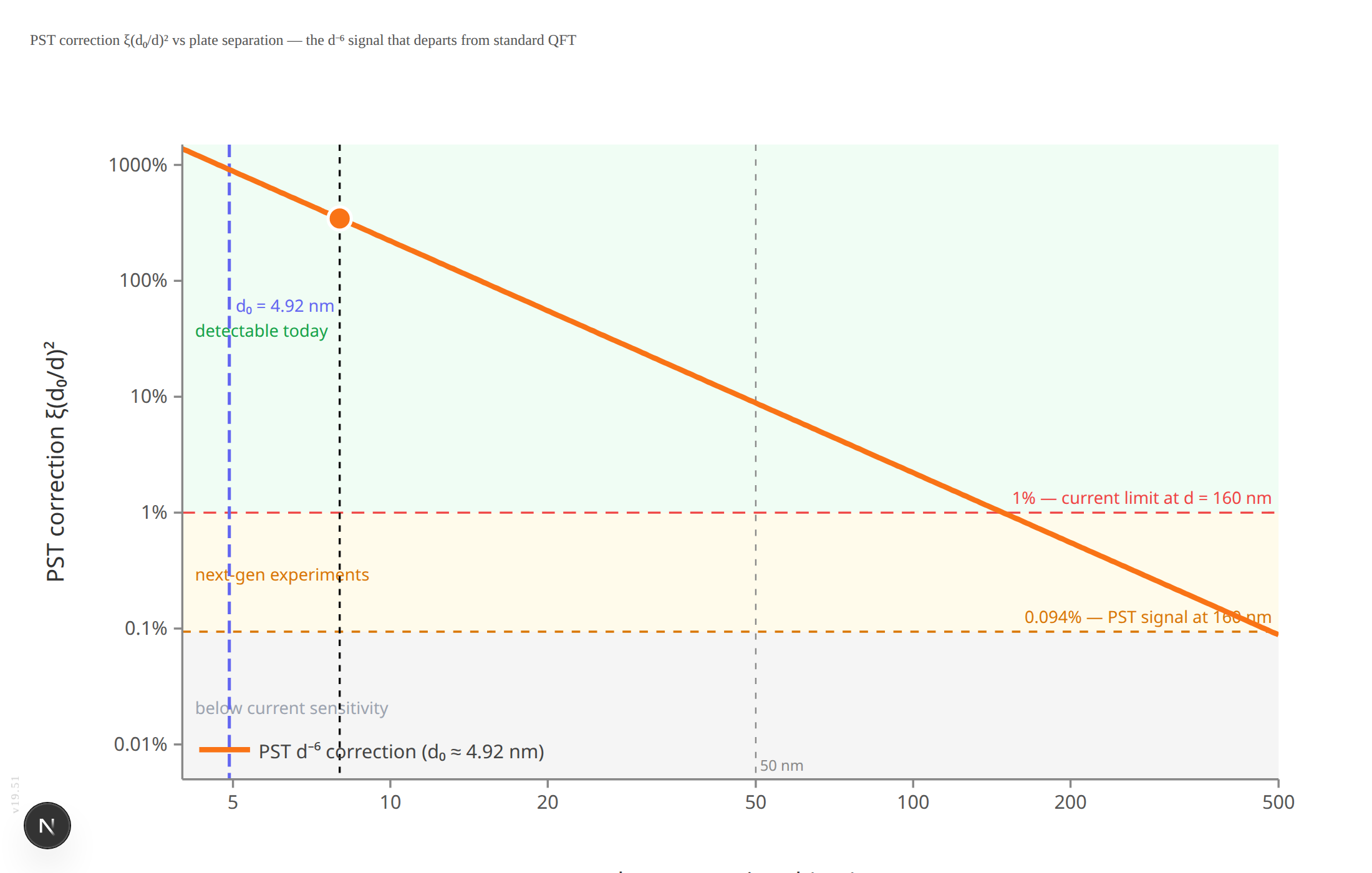
PST predicts a d−6 Casimir correction at nanometre separations , a falsifiable departure from standard QFT, distinct in scaling from the d−7retarded Casimir-Polder regime. The Gaussian convolution-kernel form is delivered structurally by the binomial-to-Gaussian CLT limit of the substrate’s Boolean projection kernel at matched scaling (Comp 73); the coefficient ξ = 90/π2 ≈ 9.12 is the matched-scaling limit, giving the diagnostic upper bound d0 ≲ 5.3 nm from current nanometre-Casimir data, the bound is set precisely because PST at d0= 5.3 nm predicts ~1% at the well-measured d = 160 nm separation. At smaller separations the signal scales as (d0/d)2: the predicted correction is up to ~10% at d = 50 nm and ~64% at d = 20 nm, outside the systematic floor of current AFM/torsion-pendulum measurements there, a clean falsification target for next-generation 1%-precision programmes. The electroweak modal scale M* = 4π mh √(2/3) ≈ 1.285 TeV follows from a parameter-free one-loop relation for the Higgs self-loop in isolation. The LG modal potential at threshold has quartic coefficient λPST= 1/4 (doublet convention), and the substrate boson–fermion mode count cancels by binomial identity (NB = NF = 2D−1), leaving the Higgs self-loop coefficient CH = 6λPST = 3/2, so mh2 = (3/2) M*2/(16π2). The constant-function substrate vacuum mode is structurally distinct from the emergent Higgs doublet (Comps 93, 97). The extension to the full Standard Model (cancelling the top, W, Z quadratic sensitivities) does not exist within PST (Comp 120): the substrate cancellation lives in a layer disjoint from the SM loops and the computed Veltman residual at M* is large and negative. M*is therefore irreducibly a scalar-sector result. The scalar sector exhibits tree-level custodial SU(2) symmetry, protecting ΔT. The cosmological-constant equation of state w = −1 follows conditionally from the substrate’s pre-spatial framing via a steady-state-style non-dilution mechanism: the substrate’s ongoing modal sublimation contributes a time-constant energy density that does not dilute under spatial expansion, so ρ̇ = 0 and the continuity equation ρ̇ + 3H(ρ + p) = 0 forces w = p/ρ = −1 exactly. The magnitude Λobs, the substrate coherence scale d0, the Yukawa hierarchies, and CKM mixing are contingent (they live in the realisation T(C) rather than the structural P1–P3 layer) and not pinned by the postulates alone.
Standing among substrate theories
Compared to the twenty-six other substrate-style & emergent-physics theories, PST is the only one that simultaneously (i) posits a finite pre-geometric substrate, (ii) derives spacetime as a limit theorem from that substrate, (iii) derives the structural ingredients of the Standard-Model gauge group from the three postulates, with the full AF = ℂ ⊕ ℍ ⊕ M3(ℂ) following via Dixon’s hyperspinor synthesis, and (iv) places the three-generation count of matter in Furey’s six-SU(3)-triplet decomposition of Cl(0,6) as the natural reading, and (v) contributes a derivation of a specific Standard-Model coupling ratio, bridge premise (B), λSM(M*) = b · e−1 ≈ 0.092 at the modal scale, matching the observed value at the ~0.8% level. The substrate-side factor e−1is derived from the foundational postulates via tensor-product factorisation forced by P1’s Bernoulli product measure (Comp 100), and the SM-side matching (B) is reduced within PST to a field-strength-renormalisation identity, substrate side closed, the all-orders decoupling exact by sufficiency of the empirical mean (only the value e−1a D → ∞ limit), a wave-function renormalisation forced into the substrate-factor form with the total reduction supplied by a unique-soft-mode theorem (Comps 110–116, 121), with the matching to the SM-measured coupling the single open step, supported at the ~0.8% level. No other entry delivers all five.
Modal sublimation into instantiated geometry. (Click to open Animation 1)
The eight-step emergence chain. (Click to open Animation 2)
Asymmetric tension crossing the modal threshold. (Click to open Animation 3)
The Casimir correction and substrate discreteness. (Click to open Animation 4)
Vacuum topology and the origin of orbital motion. (Click to open Animation 5)
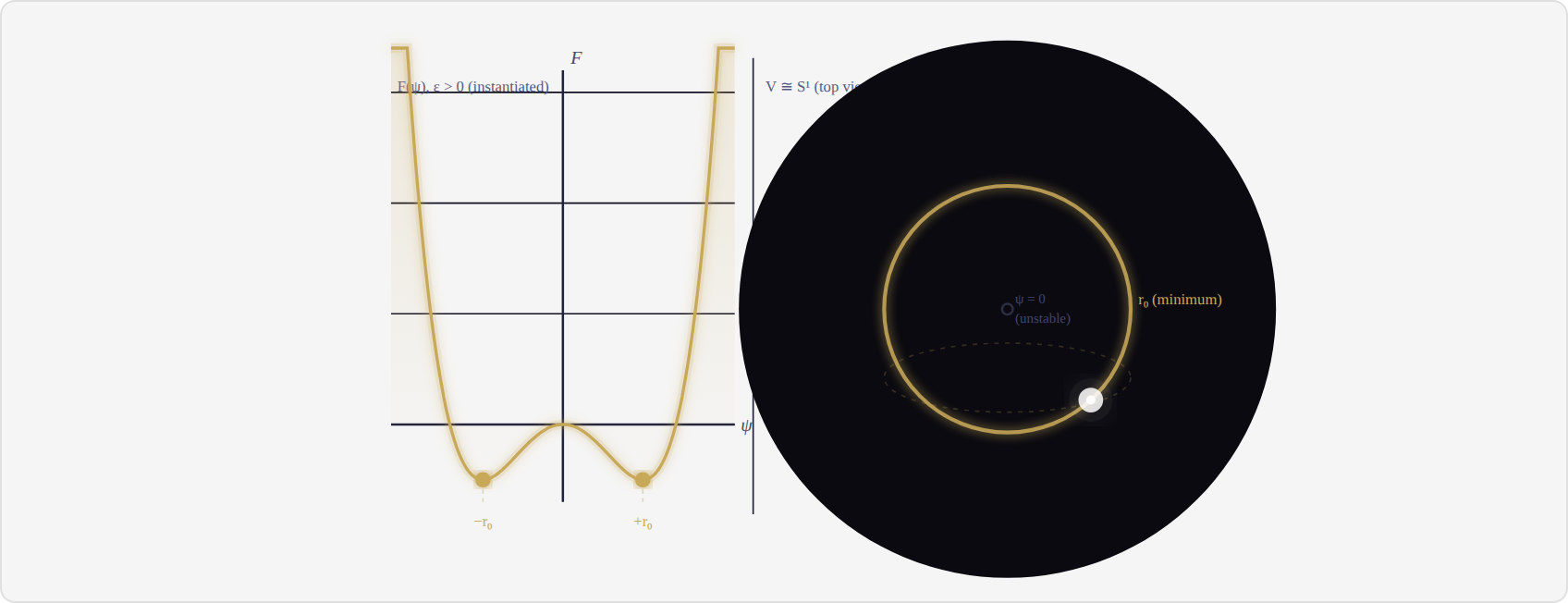
The pitchfork: spontaneous symmetry breaking at the modal threshold. (Click to open Animation 6)
Precausal Substrate Theory · Ralf Meelker · 2026